
HOME > ASSESSMENTS > BOT-3 ASSESSMENT
BOT-3 Assessment
A BOT-3 assessment is an Occupational Therapist’s assessment of a child or young person’s motor skills using the Bruininks-Oseretsky Test of Motor Proficiency. This assessment is a comprehensive measure of gross and fine motor skills across eight core subtests, from fine motor precision and manual dexterity through bilateral coordination and balance to strength and dynamic movement, with an age range of 4 to 25.
The result is a motor proficiency profile with standardised scores for each area, with the third edition adding Growth Scale Values, a new score type used across repeat assessments. Our Occupational Therapists use it as one of three sources in a paediatric motor skills assessment, alongside their own observation and a conversation with parents.
Parents, carers and participants
For Support Coordinators, plan managers, GPs and schools
Our Occupational Therapists run Bruininks-Oseretsky motor proficiency assessments with children and young people across our clinics in New South Wales and Tasmania. The Bruininks-Oseretsky test is one of the standardised assessments our Occupational Therapy team trains on internally, alongside the Peabody Developmental Motor Scales and the PEDI-CAT, and it is booked as its own service line.
How do I fund a BOT-3 assessment?
NDIS funding is the usual route for a BOT-3 assessment.
NDIS: as Occupational Therapy supports, the assessment and report usually come out of the Capacity Building part of a plan; our intake team confirms the category.
Self-managed, plan-managed or NDIA-managed: we work with all three.
Privately funded: available if you don’t have a plan, and you’ll get a clear picture of the costs before you book.
If you are not sure which funding applies to you, call us on 1800 678 647 or email hello@opt.net.au. We will sort it out before your first appointment.

Not Sure What Fits Your Plan?
1800 678 647
Don't want to call? Click here to
Fill in an enquiry form.
We Can't Wait to Meet You
What a BOT-3 assessment involves
01
What is the BOT-3 assessment for?
The BOT-3 (and the BOT-2) measures motor proficiency, meaning how well a person performs fine and gross motor tasks. It is built for people with mild to moderate motor challenges.
At Optimum Health Solutions our Occupational Therapists use it as part of a paediatric motor skills assessment, alongside clinical observation.
As an Occupational Therapy assessment, the BOT-3 provides a structured picture of where a child’s motor skills sit currently. That picture is what a school, a therapy plan or an NDIS planning conversation needs.
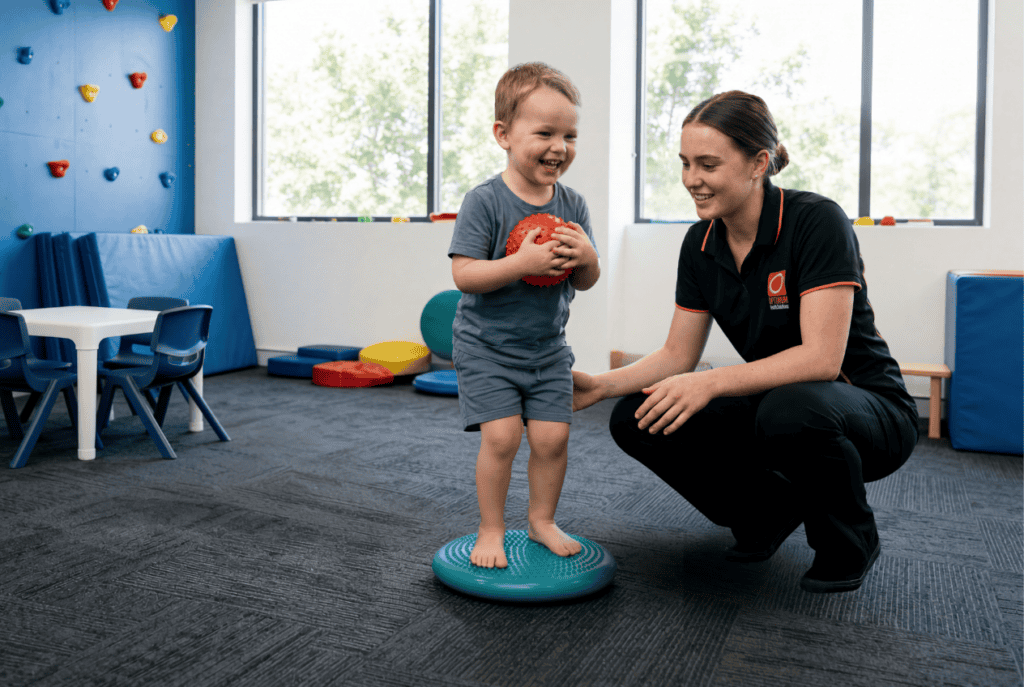
In practice the fine motor half looks at things like drawing, cutting and threading, and the gross motor half at things like balancing, catching and moving at speed.
02
What are the sections of the BOT-3 test?
The BOT-3 has eight core subtests:
- Fine Motor Precision
- Fine Motor Integration
- Manual Dexterity
- Upper Limb Coordination
- Bilateral Coordination
- Balance
- Strength
- Dynamic Movement
- plus one supplementary subtest, Extended Balance.
There are also supplemental composite scores:
- Skilled Manual Performance
- Movement Fundamentals and Motor Planning
- Coordination.
03
How is the BOT-3 administered?
The BOT-3 is administered one to one by a trained clinician, at Optimum Health Solutions an Occupational Therapist. The full assessment takes approximately 50-90 minutes, with the Fine Motor section taking 25-45 minutes and the Gross Motor Form taking 25-45 minutes.
Which assessments your child focuses on depends on the purpose of the assessment, for example, for a report for a school or the NDIS.
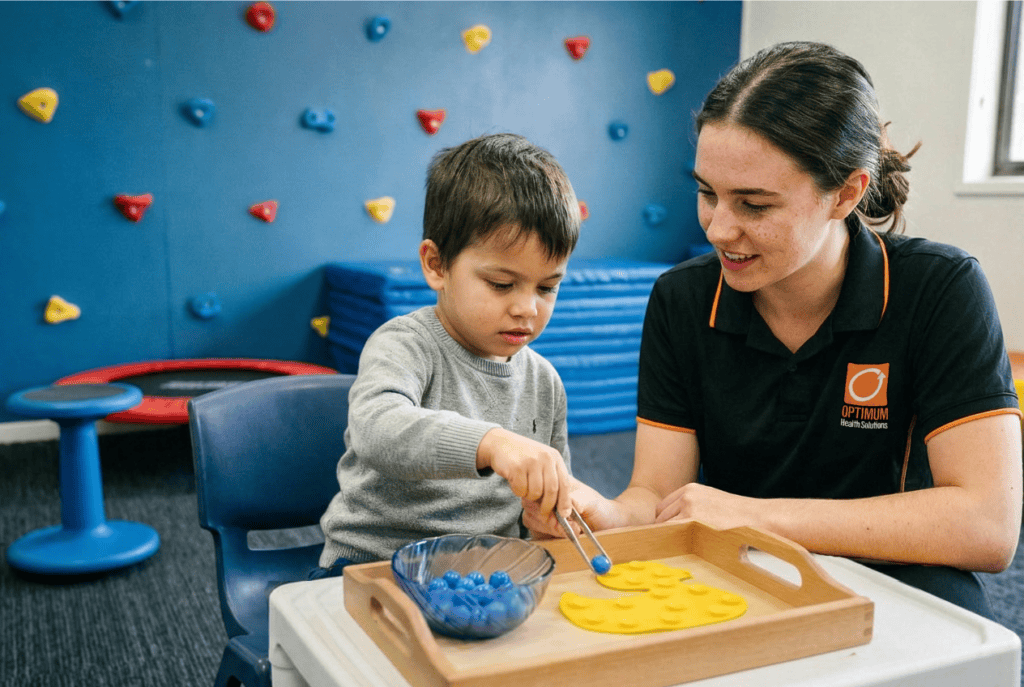
To a child it looks like a series of games with pencils, beads, a ball and balance tasks, and your Occupational Therapist records how each task is done as well as the score. If your child was assessed before 2024, you may be wondering about the older edition.
04
Is the BOT-2 still valid?
The BOT-2 was superseded by the BOT-3 in 2024 and the BOT-2 Q-global reports and subscriptions stopped being supported on February 28, 2026.
This just means it was retired in favour of a newer version with refreshed norms and updated subtests. It does not change what an earlier result recorded.
A BOT-2 score describes how a child performed on the day against the group that edition was scored against. If your child was assessed with the BOT-2 in the past, that result is still a recognised baseline.
Optimum Health Solutions is moving to the BOT-3, and some clinics are completing their remaining BOT-2 assessments first, so your Occupational Therapist will tell you which edition your child’s assessment will use when you book.
05
How is the BOT-3 different from the BOT-2?
The most visible change is the age range, 4:0 (4 years) to 25:11 (25 years and 11 months) against 4:0 to 21:11 (21 years and 11 months) for the BOT-2.
The structure is “eight core subtests and one supplementary subtest”: the core eight keep most of the BOT-2’s names, with Dynamic Movement in place of the BOT-2’s Running Speed and Agility, and Extended Balance as the supplementary subtest.
New supplemental composite scores including Motor Planning and Coordination, Growth Scale Values, and longer completion times than the BOT-2.
The normalised assessment baselines are US based in both editions.
06
How much does the BOT-3 assessment cost?
The cost of a BOT-3 assessment depends on which form of the assessment is used, whether it sits inside a wider motor skills assessment, and how detailed the report has to be.
For NDIS participants, the motor proficiency assessment is listed as its own service line in our Occupational Therapy services.
If you’re paying privately, you’ll get a clear picture of the costs before you book.
After you inital referral, our intake team can also tell you how a BOT-3 assessment relates to a broader Occupational Therapy assessment before anything is booked.
How our Occupational Therapists run the BOT-3 assessment
It starts with the reason for the referral. Your Occupational Therapist will ask what you and the school have noticed, whether that is handwriting, buttons, catching a ball or keeping up in the playground. They’ll ask what you want the assessment to answer. From that they will decide which form of the BOT-3 fits, and whether it should sit inside a wider paediatric motor skills assessment.
The session itself is a set of structured tasks done one to one. Your Occupational Therapist will score each one against the age norms. They’ll also note what the test alone doesn’t capture: how your child approaches a new task, their attention and focus, and how the clinic performance compares with home or school.
After the session your Occupational Therapist will write the report, which brings the test scores, the observations and your account together in one document. You’ll get it to keep and share with the school or your NDIS planner, and, where therapy follows, the goals are written in everyday language and measured in everyday tasks. A repeat assessment is usually suggested around twelve months after the first.


BOT-3 assessments through the NDIS
For NDIS participants a BOT-3 assessment is usually funded from the Capacity Building part of a plan, as part of Occupational Therapy supports; our intake team confirms the category in the plan.
Motor proficiency assessment is a named service line in our Occupational Therapy services. The report gives a family and their planner a standardised baseline of motor skills to bring to a planning conversation, alongside the Occupational Therapist’s recommendations for therapy or school support.
Support Coordinators and plan managers can refer directly through our Referrers Hub, and we’ll confirm the funding line before the first appointment.
NDIS
Referrals

14 clinics across NSW & Tasmania
Email us
hello@opt.net.au
Speak to us
1800 678 647
Get in Touch.
Where we offer BOT-3 assessments
Common questions about BOT-3 assessments
What is the BOT-3 assessment for?
What are the sections of the BOT-3 test?
How is the BOT-3 administered?
How is the BOT-3 different from the BOT-2?
Is the BOT-2 still valid?
Can I still use the BOT-2?
How much does the BOT-3 assessment cost?
How much is the BOT-3?
Reviewed by Sarah-Louise Higgins

You May Also Like:

Helping Children Reach Their Learning Potential
– By Siri Burke, Speech Pathologist at Optimum Health Solutions Sylvania. The early years of development are essential for laying a solid foundation for children to learn and grow. Giving

The Importance of Literacy Development
Literacy is the ability to read, write, and spell. It is a learned skill that can start developing when a child is in the preschool period. Literacy is a big

Pre-linguistic Skills and Early Language
Pre-linguistic skills are known as the skills children need before they begin to talk. These skills are the foundations for communication. While the main goal for families is usually to